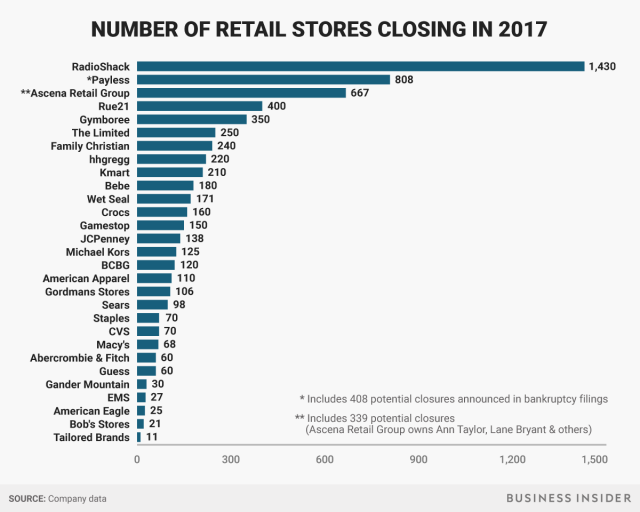
Whole Foods is cutting medical benefits for hundreds of part-time workers

The changes will take effect on January 1 and affect just under 2% of Whole Foods’ total workforce, a Whole Foods spokesperson told Business Insider.

Whole Foods has about 95,000 employees, so it means about 1,900 people will lose benefits.

The benefits that the company is cutting are offered to part-time employees who work at least 20 hours a week. The changes will not affect full-time employees.

Whole Foods said it was making the change “to better meet the needs of our business and create a more equitable and efficient scheduling model.”

https://www.businessinsider.com/whole-foods-cuts-medical-benefits-for-part-time-workers-2019-9

Jobs in Jeapordy – Los Angeles Teachers Strike

Los Angeles teachers walked off the job Monday morning in their first strike in 30 years, placing hundreds of thousands of students in limbo.
About 31,000 members of the teachers union had agreed to walk out to try to win smaller class sizes, more support staff at schools and better pay.

Thousands of picketing teachers and other union members — many of whom had arrived at their schools before sunrise — joined the midmorning downtown rally in the chilly rain along with some students and parents. Then they marched roughly a mile to school district headquarters on Beaudry Avenue.

.https://www.latimes.com/local/education/la-me-edu-lausd-teachers-strike-20190114-story.html


EVEN GOVERNMENT JOBS ARE NOT SECURE

Trump moves to freeze pay for federal workers amid government shutdown

Amid the current partial government shutdown, President Donald Trump signed an executive order to freeze pay for federal workers in 2019.  Some federal employees affected by the partial government shutdown are facing uncertainty as they return to work after the Christmas holiday. About 420,000 who are considered essential are working unpaid. (Dec. 26) AP

https://www.usatoday.com/story/news/politics/2018/12/29/trump-moves-freeze-pay-federal-workers-amid-shutdown/2439801002/

US government shuts down; Dems, GOP blame each other

http://www.foxbusiness.com/markets/2018/01/20/us-government-shuts-down-dems-gop-blame-each-other.amp.html

The federal government shut down at the stroke of midnight Friday, halting all but the most essential operations and marring the one-year anniversary of President Donald Trump’s inauguration in a striking display of Washington dysfunction.

Last-minute negotiations crumbled as Senate Democrats blocked a four-week stopgap extension in a late-night vote, causing the fourth government shutdown in a quarter century. Behind the scenes, however, leading Republicans and Democrats were trying to work out a compromise to avert a lengthy shutdown.

Congress scheduled an unusual Saturday session to begin considering a three-week version of the short-term spending measure — and to broadcast that they were at work as the shutdown commences. It seemed likely each side would try forcing votes aimed at making the other party look culpable for shuttering federal agencies.

Since the closure began at the start of a weekend, many of the immediate effects will be muted for most Americans. But any damage could build quickly if the closure is prolonged. And it comes with no shortage of embarrassment for the president and political risk for both parties, as they wager that voters will punish the other at the ballot box in November.

Social Security and most other safety net programs are unaffected by the lapse in federal spending authority. Critical government functions will continue, with uniformed service members, health inspectors and law enforcement officers set to work without pay. But if no deal is brokered before Monday, hundreds of thousands of federal employees will be furloughed


.

AT&T Announces Thousands of Layoffs, Firings Just in Time for Christmas

AT&T plans to lay off and fire more than a thousand workers starting early next year, according to local reports.

Across the Midwest, an estimated 600 workers were notified they were being laid off by the company on December 16, a week before AT&T announced it was doling out $1,000 bonuses to 200,000 of its employees in celebration of the Republican Party’s tax overhaul.

The telecommunications giant told the Chicago Tribune in a statement that the most of the affected workers are from its landline and other legacy service sectors, but the company did not say how many workers total would still be employed in 2018.

https://www.yahoo.com/news/t-announces-thousands-layoffs-firings-205347737.html

Holiday shoppers will spend more online than in-store for the first time, according a new survey.

Deloitte’s 32nd annual holiday survey has revealed more than half (51%) of holiday shoppers expect their budget to be spent online, compared to 42% who will spend in stores.

The news should excite online retailers who have fought hard to steer customers online during the lucrative holiday season.

Rod Sides, vice chairman of Deloitte, said in a statement:

“It’s the lure of shopping and the experience that is flourishing and likely to remain in high demand — all which bodes well for retailers that have created an experience blending one-of-a-kind items, inspiration, uncomplicated navigation and frictionless transactions”

Sides says total holiday spending has been increasing over the last five years, and bricks and mortar retailers should have seen the online holiday spending boom coming.

https://www.eshopworld.com/news/christmas-online-shopping/


Here’s How Much the Average 50-Something American Has Saved for Retirement

Your 50s are a pivotal time not just in your career, but on the road to retirement. By the time your 50s roll around, you’ll have conceivably been working for a good 30 years, which means your earnings will likely have peaked. It also means you might finally be done with college tuition, especially if you had children earlier on.

But no matter what life happens to look like for you by the time you hit your 50s, it’s critical to do a serious evaluation of your retirement savings and take steps to either keep up the good work or strive to do better. That’s because retirement may be just a mere decade away, assuming you plan to leave the workforce around the same time that most older Americans call it quits.

So just how much money should you have saved in your 50s? Fidelity insists that by age 55, you need the equivalent of seven times your salary socked away, and that’s a pretty good benchmark to follow. Since the typical American earns roughly $50,000 during his or her mid-50s, that means that ideally, you should have about $350,000 tucked away for the future by that point. And unfortunately, the average 50-something American is nowhere close to being on track.

The average 50-something American’s savings level

So how much does the typical worker in his or her 50s have saved for retirement? The Economic Policy Institute reports that for households between 50 and 55, the average savings balance is $124,831. For those between 56 and 61, that number comes in a bit higher, at $163,577.

But these figures don’t tell the whole story. Because a select pool of strong savers can bring up the average and compensate for poor savers, it’s often more helpful to look at the median savings amount for these age groups. For households between 50 and 55, the median retirement account balance is just $8,000. For those between 56 and 61, it’s $17,000 — not much better. And when you have a situation where the median is considerably lower than the average, it means that most 50-somethings have less than average.

In other words, the average American in his or her 50s has a lot of catching up to do on retirement savings. And if you’re one of them, let this be your wakeup call.

Why we’re not saving more

It’s easy to make excuses for not saving at any age. For many adults in their 50s, the reason boils down to mounting expenses and high levels of debt. Case in point: The typical mid-50s household has a credit card balance of $8,158 to $9,096, and that’s the sort of debt that could easily thwart one’s savings efforts. Throw in the fact that many 50-somethings are paying off student loans on behalf of their children, and it’s no wonder retirement falls by the wayside.

https://www.yahoo.com/finance/news/apos-much-average-50-something-110000289.html


The Hourly Income You Need To Afford Rent Around The U.S.

The average full-time minimum wage worker can’t afford rent in ANY state.

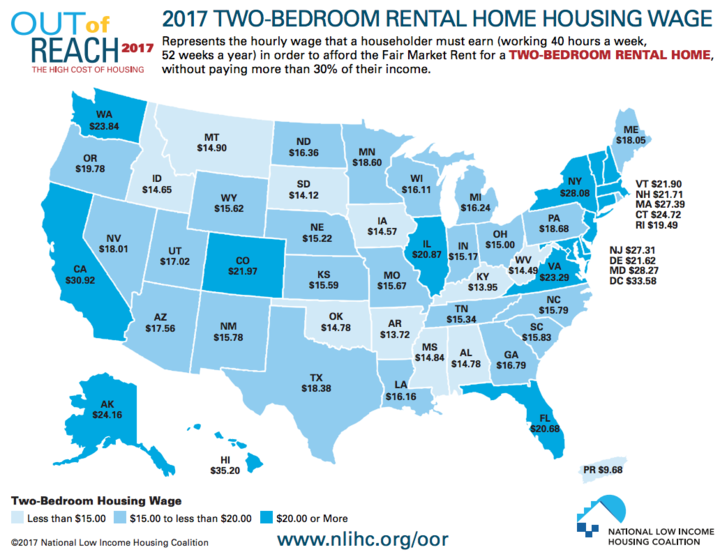
Full-time workers who make minimum wage can’t afford a two-bedroom rental home in any state in the U.S. without spending more than the recommended 30 percent of their income, according to a report from the National Low Income Housing Coalition.

The group’s annual “Out of Reach” report compares minimum wages and housing costs in states, metropolitan areas and counties across the country. This year’s results show the hourly wage rate needed for a “modest” two-bedroom rental is more than double the federal minimum wage of $7.25 per hour in all but four states.

http://www.huffingtonpost.com/entry/how-much-you-need-for-rent_us_5942cc92e4b0f15cd5b9e2ee